
Imagine a business where every call is answered quickly and clearly—without hold music or dropped lines. Thanks to rapid advances in AI call assistant technology, this is now real. From small and medium businesses (SMBs) to large contact centres, AI call assistants are reshaping telephony. As models improve and speech becomes near-human, companies can automate routine calls and lift the quality of every conversation. This guide explains how AI call assistants work, where they add value, the core architecture, the ROI you can measure, and what comes next. AI call assistants change how businesses answer, route, and manage calls. Unlike old IVRs or voicemail, modern assistants use Automatic Speech Recognition (ASR), Text-to-Speech (TTS), and large language models (LLMs). As a result, they hold natural two-way conversations and automate tasks in real time. Moreover, these systems provide 24/7 coverage across PSTN, SIP, or VoIP with strong cost control and easy scaling. They handle simple jobs—like routing and spam screening—and also complex tasks such as booking, data capture, and call handoffs. Meanwhile, the tone stays human-like. In addition, they integrate with CRM systems and calendars. With real-time intent detection and compliance frameworks (PCI, GDPR, HIPAA), they lift both customer experience and operational results. Market platforms such as Call Assistant AI, Synthflow, Lindy, and HiCall show many deployments. For example, they support appointment booking, outbound qualification, after-hours answering, multilingual help, and more. Therefore, adopting AI call assistants is now a strategic move. It lifts satisfaction, reduces costs, and frees human agents for higher-value work. AI call assistants combine several technologies in one pipeline:
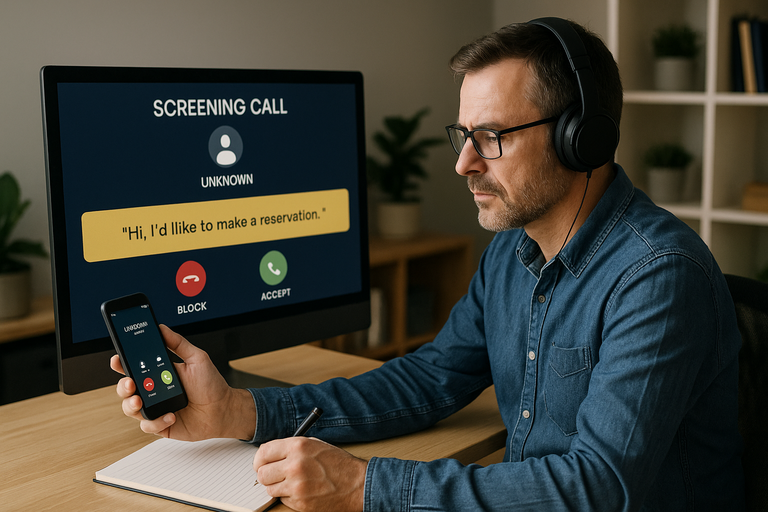
Intelligent Screening and Spam Blocking Assistants screen unknown callers and robocalls by asking intent and transcribing replies. For example, Call Assistant AI and HiCall let users review transcripts before letting a call through. This reduces noise while important contacts still connect.
The New Era of AI Call Assistants in Business Telephony
 AI call assistants change how businesses answer, route, and manage calls. Unlike old IVRs or voicemail, modern assistants use Automatic Speech Recognition (ASR), Text-to-Speech (TTS), and large language models (LLMs). As a result, they hold natural two-way conversations and automate tasks in real time. Moreover, these systems provide 24/7 coverage across PSTN, SIP, or VoIP with strong cost control and easy scaling. They handle simple jobs—like routing and spam screening—and also complex tasks such as booking, data capture, and call handoffs. Meanwhile, the tone stays human-like. In addition, they integrate with CRM systems and calendars. With real-time intent detection and compliance frameworks (PCI, GDPR, HIPAA), they lift both customer experience and operational results. Market platforms such as Call Assistant AI, Synthflow, Lindy, and HiCall show many deployments. For example, they support appointment booking, outbound qualification, after-hours answering, multilingual help, and more. Therefore, adopting AI call assistants is now a strategic move. It lifts satisfaction, reduces costs, and frees human agents for higher-value work.
How AI Call Assistants Work: Core Technologies and Systems Architecture
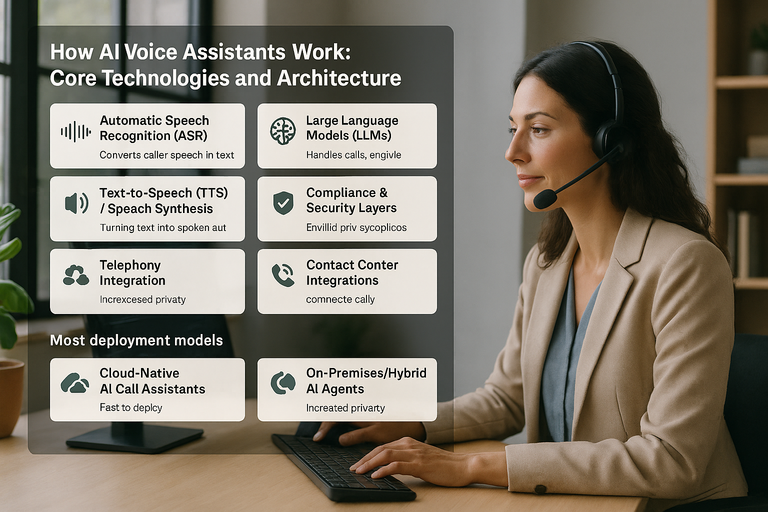 AI call assistants combine several technologies in one pipeline:
- Automatic Speech Recognition (ASR): Converts speech to text with high accuracy. It also handles many accents and background noise in real time.
- Large Language Models (LLMs): Understand intent, manage dialogue, route calls, and generate contextual replies.
- Text-to-Speech (TTS): Produces natural-sounding audio. It supports branded voices and many languages.
- Telephony Integration: Routes calls across PSTN, SIP, or VoIP and hands off to humans when needed.
- APIs and CRM Connectivity: Pulls data, books appointments, processes orders, and shows caller context.
- Security and Compliance: Meets PCI DSS, GDPR, HIPAA, and Australia’s Privacy Act. It uses encryption, anonymisation, and clear retention rules.
- Cloud-native: Fast to launch and easy to scale. Ideal for SMBs and distributed teams.
- On-prem or Hybrid: More control and privacy. Good for strict regulatory needs with on-device or private-cloud options.
- Contact-centre integrations: Works with Genesys, Five9, Twilio, and Avaya for advanced routing, reports, and live-agent escalation.
Key Use Cases: How AI Call Assistants Drive Business Transformation